
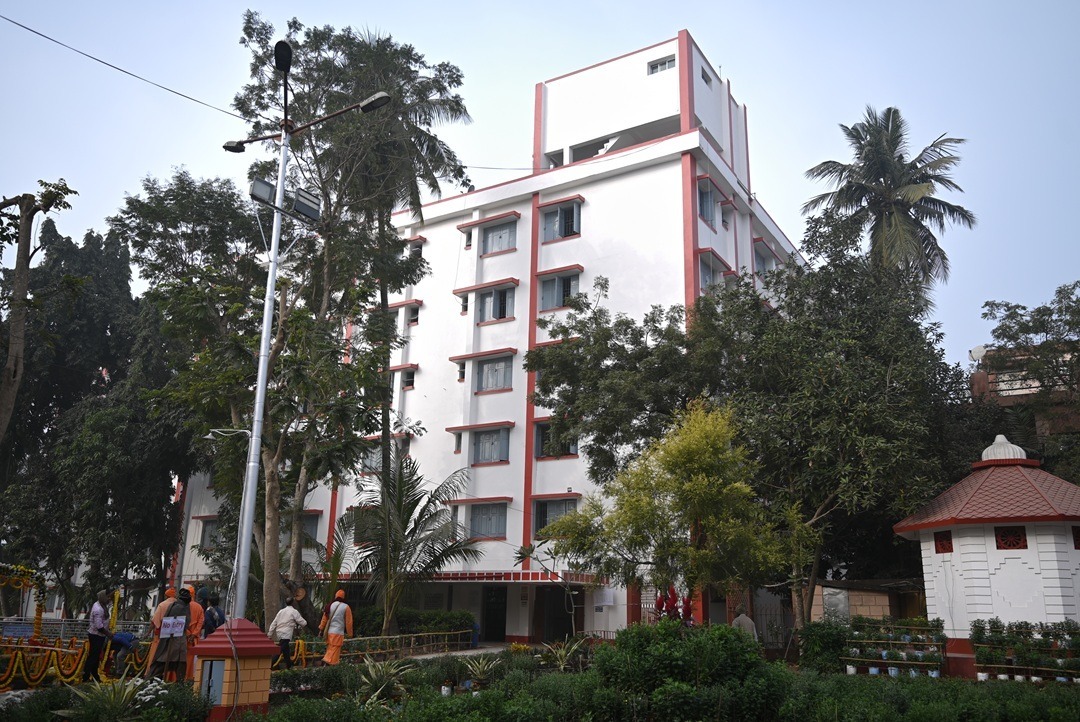
Home for Aged People
- Single rooms with attached bathrooms provide privacy and comfort for those who prefer a personal living space.
- Both male and female residents fostering a harmonious environment.
- Among the residents, some are provided free accommodation, reinforcing the Math’s commitment to serving those in need.
- Personal hygiene and grooming.
- Assistance with meals and medication.
- Emotional and social support to ensure their psychological well-being.
- Spiritual and philosophical works, especially those related to Swami Vivekananda and Ramakrishna Paramahamsa.
- Literature on history, culture, psychology, and other subjects.
- Magazines and periodicals offering insights into national and global affairs.
- Thought-provoking journals on spirituality, meditation, and humanitarian efforts.
- Wavy Waters (karma yoga)
Swamiji points to the wavy waters as symbolic of Karma. Karma means activity. According to Sri Ramakrishna, the Ultimate Reality has two inseparable characteristics—static and dynamic. The same reality, which is static, when active, becomes dynamic. He said that these two sides of the Ultimate Reality are as inseparable as fire and its burning power.
Wavy waters represent the dynamic aspect of reality. Water is one of the five elements, which, according to Hindu cosmology, constitute the whole of the visible and invisible material world. Purusha Sukta says, ‘From water came creation (adbyah sambhutah).’ This idea of creation states that though One, the Ultimate Reality, decided to become many. From this was born Hiranyagarbha (the Golden Womb) and from that came all elements of nature including water.
Like wavy water, this world of Karma is always in motion. It is ever changing, ever taking new forms, creating fresh situations and perspectives. That is what this world is—a bundle of constant change. In Sanskrit, this ever-changing world is often called bhava-sagara, the ocean of relative existence. A karma yogi learns to travel through this restlessness of change by remaining calm and detached. He is like the proverbial lotus leaf which never gets wet though it is in touch with water always. Sri Ramakrishna best describes the ideal of a karma yogi when he likens the human mind to a boat. He said that the boat can be in water, but the water should not be in the boat.
Karma Yoga is the art of remaining detached, unaffected by the results of action, good and bad. It is not running away but facing the challenges of life through skilful action. As Swami Vivekananda said, ‘Do not fly away from the wheels of the world-machine but stand inside it and learn the secret of work. Through proper work done inside, it is also possible to come out.’
Water, thus, is a symbol of Karma Yoga.
- Lotus (bhakti yoga)
Lotus represents heart. It is not the physical heart but the spiritual heart that the lotus represents. Mahanarayana Upanishad says, ‘In the citadel of the body, there is the small sinless and pure lotus of the heart which is the residence of the Supreme.’
The lotus also represents purity and non-attachment, and is a symbol of Bhakti or love for God. Most people let their love flow towards the world. But a devotee redirects his love only towards God, who resides in one’s heart. Though God is present everywhere, it is in the heart, our spiritual centre, that he manifests most. The heart of the devotee is the ‘Lord’s drawing room.’
Loving God does not mean offering an elaborate ritualistic worship but offering one’s love and heart to him. God is pleased not by what is given to him but how that is given to him. Narada calls Bhakti or love of God as its own greatest reward. Bhakti is not a means to an end, but an end in itself.
Lotus, thus, is a symbol of Bhakti Yoga.
- Rising Sun (jnana yoga)
Knowledge is always compared to light. For, like light, knowledge reveals the truth. It removes the cover of ignorance. Traditionally, sun has been considered the God of knowledge or light. Millions of Hindus chant Gayatri Mantra everyday, praying for knowledge and awakening of the higher intellect to the presiding deity of the sun (savitr). According to Swamiji, rising sun represents Jnana or the path to Jnana. Jnana yoga aims at removing the covering of ignorance that envelops the atman by purification of mind and negation of the very existence of ignorance. It is the path of ‘not this, not this.’
Jnana yoga is not about gaining more and more knowledge about the objects of the senses, or to have more ideas contained in books, but it is a process of dis-covering the inherent Self. It is a search for the subjective knowledge, and ultimately, through that, discovering the underlying existential foundation of the whole world and even beyond. It is a journey of the alone to the Alone, which is of the nature of Existence-Knowledge-Bliss (sat-chit-ananda).
Rising Sun, thus, is a symbol of Jnana Yoga.
- Encircling Serpent (raja yoga)
Serpent represents Kundalini. Kundalini actually means ‘coiled up.’ Hindu scriptures emphatically confirm the presence of a latent spiritual power present in everyone and call it Kundalini. In the physiological framework, Kundalini is supposed to lie at the base of the spinal column—the first and the lowest of the six chakras (centres) along the spinal column. When this kundalini power is asleep, as it were, one remains busy with eating, sleeping and procreating. For such a person, the world begins and ends only in attending to one’s material needs. It is only when he begins to live a life of self denial, service, and prayer (i.e., when the higher life begins to appeal to him), the upward journey to higher centres commences.
A systematic approach to channelling and guiding of one’s spiritual power has been expounded in Patanjali’s Yoga Sutras. The basic principle of this yoga of mind control is to dis-identify us from the body-mind through meditation and concentration. This path is called the Royal Path, Raja Yoga, because it is the most direct approach to the science of spirituality.
Encircling Serpent, thus, is a symbol of Raja Yoga.
- Swan (paramatman)
The swan is a symbol of the Ultimate Reality for more than one reason. Swan represents knowledge born of the discrimination between the Real and the unreal. This is based on the belief that if milk diluted with water is given to a swan, it sips only the milk, leaving the water behind. Water represents ignorance or the unreal. Milk symbolizes knowledge or the Real. Upanishads speak of Hamsa-Gayatri (mantra in praise of hamsa or swan), which is chanted during certain rituals.
Om hamsa hamsaya vidhmahe paramahamsaya dhimahi / Tanno hamsah prachodayat Om. May we know the Light of lights. For that, we meditate on the Supreme Light. May the Divine Light impel us towards it.
One of the interpretations of hamsa is Sun, representing Light and Knowledge. Srimat Bhagavatam (11.13:15-21) even mentions imparting of knowledge by God in the form of a hamsa.
Swami Vivekananda believed that by the combination of these four yogas (Karma, Bhakti, Jnana and Raja Yoga), the experience of the Supreme Reality (represented by Swan) can be had. Not only that. Realizing the Supreme Reality is the real, ultimate aim of human existence, too. Religion becomes fulfilled only when one experiences that Reality. Says Swamiji, ‘If there is God, we must see Him; if there is a soul, we must perceive it . . . ’
General Information & Rules
PREAMBLE
Ramakrishna Math, Barisha maintains a ‘Home for the Aged’ where aged people can lead a life that is simple, noble and peaceful just as in a Vanaprastha Ashrama. For maintaining the peaceful and harmonious atmosphere of the Home it is necessary for all the inmates of the Home to follow the rules and regulations given here. The following words, quoted in bold, occurring in the body of this document unless excluded by the context, will mean as follows:
- Management means Adhyaksha of Ramakrishna Math, Barisha.
- Home means ‘Home for the Aged’ run by Ramakrishna Math, Barisha.
- Inmate means anyone who has gained admission to the ‘Home for the Aged’.
(i) Admission
(a) Devotees who have faith in spiritual values and have studied the lives and teachings of Sri Ramakrishna Sri Sarada Devi and Swami Vivekananda but have none to look after them in their old age are ‘eligible to apply for staying in the *Home for the Aged’, hereafter referred to as ‘the Home.’
(b) For admission to the Home applications will be entertained only from those who are 60 years or above in age. The Management, however, reserves the right to relax this rule under special circumstances.
(c) Bachelors and widowers will be allowed to stay only in the first four floors. The fourth floor or fifth storey) is reserved for married couples and the fifth floor (top most floor) or women only. Preference will be given to the parents/siblin s(s) of the monks of Ramakrishna Order, or accommodation in fourth and fifth floors.
(d) The Home is not a hospital. Hence, admission to the Home depends on medical fitness. Candidates seeking admission should be ready to undergo medical examination(s) by the authorized medical consultants of the Home at their own cost.
(e) In order that the Managemant can plan and arrange appropriate medical care and attention whenever an inmate falls sick, he/she shall, at the time of his/her admission to the Home, furnish a statement in the form of an AFFIDAVIT prescribed in this regard wherein the details of major illness (es) he/she has suffered earlier shall be furnished, and he/she shall also disclose if he/she had ever been put on steroidal drugs/medication and the medicines he/she normally takes.
(f) Any one suffering from mental/psychic disorder or any communicable disease or has had a history thereof or one who has lost his/her vision or auditory capacity or is dumb or orthopaedically handicapped so severely as to affect his/her movements is not eligible for admission. In case it is found later that information in this regard had been withheld by the applicant, he/she will be immediately discharged from the Home and the Guarantor/Relative(s) shall be bound to take him/her back.
(g) Candidates must be free from all liabilities and obligations, whatsoever towards his/her relatives or friends.
(h) Admission to the Home will be provisional for the first three months, at the end of which, the management will confirm the admission. if the candidate is found suitable.
(i) No person who is involved in any criminal litigation shall be eligible for admission. In case the applicant is involved in civil litigation the Management reserves the right to refuse admission.
(j) No advance booking of seats is possible.
(ii) Deposits and Monthly Charges
(a) Each inmate of the Home shall have to deposit with Ramakrishna Math, Barisha, a sum of Rs. 2,00,000/- (Rupees Two lacs only) as Security Deposit. This amount shall not earn any interests to the depositor but is refundable to him/her after adjustment of outstanding dues, if any, at the time of discharge of the inmates from the home, if it is within five years from the date of admission and after expiry of five years the said Security deposit will continue as such but it shall become not refundable. The said security Deposit shall be assets of Ramakrishna Math, Barisha if the said inmate would leave the Home after five years or if the inmates expires.
(b) Towards meeting any unforeseen expenditure with regard to medical treatment Hospitalization each inmate of the home shall have to keep a minimum deposit of Rs. 3,00,000/- (Rupees Three lacs only) with Ramakrishna Math, Barisha, as Medical Deposit. This amount is not refundable to the depositor. The income earn on this deposit will be added to the principal amount keeping in view of the escalation in the cost of Medical Treatment. If any expenditure is made from the said Medical Deposit on account of any medical treatment I Hospitalization, the depositor shall deposit the said amount to make the said Medical Deposits Rs. 3,00,000/-. On the death of the depositor or in the case the depositor leaves the Home the said medical deposit shall become the property of The Ramakrishna Math, Barisha.
(c) Monthly charge for boarding and lodging of an inmate is Rs. 6,000/– (Rupees six thousand only) per month.
(d) Monthly charge is to be paid within the 10th day of the current month i.e. within 10th November for the month of November.
(e) Non-payment of dues for two consecutive months will make the defaulting inmate liable to be fined.
(f) Full charges for the month shall be payable even if an inmate happens to stay away from the Home for certain period of a month in question. No pro rata reduction of charges on account of such absence from Home shall be allowed. However, for an absence of the entire month in question, 50% of the monthly charge shall have to be paid.
(g) If an inmate wants to use an air conditioner or a room heater in his/her room, he/she will have to bear the cost of purchasing and installing the equipment. An additional amount of Rs.1,000/- (Rupees one thousand only) per month will have to be paid by the inmate for using these facilities apart from the charges of the electricity consumed. A private electric meter will be installed at the room for using such room heater/ air conditioner and the electricity charges shall be calculated on the basis of the unit consumed as per the said electric meter reading multiply by the electricity charge unit as per the CESC bill for the relevant month electricity consumed X electric charge per unit for relevant month Room heater/Air Conditioner electricity consumption charges.
(h) The Management reserves the right to admit any candidate to the Home free of charges and/or with the benefits of concessional charges on the merit of case.
(i) The monthly charges are subject to revision every two/three year by the Management and shall be binding on all the inmates.
(j) An inmate may deposit a lump sum amount with Ramakrishna Math, Barisha. in order that his/her boarding and lodging expenses may be defrayed out of the income generated by it. The amount so deposited is refundable. Nomination is allowed for such deposit.
(k) Every inmate must ensure that the minimum amount of Rs. 3,00,000/(Rupees three lakh only) is always maintained in the Medical Deposit by replenishing any withdrawal from it.
(1) Unconditional donations/charities made by the inmate, if any, at any time. should not be linked with his/her admission into the Home or stay at the Home or discharge from the Home, nor can those be treated as ‘deposit’ with Ramakrishna Math, Barisha. Such contributions are not refundable.
(m) If an inmate is unable to pay the charges mentioned above, he/she may apply to the Management for concession.
iii. General Instructions
(a) The furniture, bedstead and bedding (including mattress, pillow, pillowcase. mosquito-net, quilt, etc) shall be supplied by the Management. The candidate has to bring with him/her, and provide for, all his/her personal necessities such as clothes, toothpaste, toothbrush, hair oil, shaving set and other daily necessities. The inmates are advised to keep minimum luggage with them.
(b) Standard of living and facilities will be simple and same for all inmates.
(c) Vegetarian and non-vegetarian meals shall be served from the common kitchen. However, the Management reserves the right to supply non-vegetarian meals only on specified dates. Though attempts will be made to satisfy the inmates to the extent possible with regard to food, no inmate can claim a certain type of meal as a matter of right.
(d) All inmates are expected to take part in cultural, religious and social activities conducted by the Management and also help the Management in organizing them.
(e) The inmates may meet their visiting relatives or friends in the Visitors’ Room during ‘visiting hours’ only. No visitor should be taken to the living room without written permission from the Management.
(f) The visitors will not be allowed to stay beyond the visiting hours.
(g) Visitors like agents/brokers may be allowed to meet the inmates only with written permission from the Management.
(h) Inmates should not go out of the Home’s campus without informing the Management. Before going out they should make an entry regarding the time, date and the purpose of going out in a Register maintained for that purpose in the office. On returning to the Home, they should also enter the time and date of their return in that Register.
(i) In all matters pertaining to the Home the decision of the Adhyaksha of Ramakrishna Math, Barisha, will be final and shall be binding on all.
(j) The management reserves the right to make any addition/alteration to the Rules of the Home keeping in mind the interests of the Home and such a revised set of Rules shall be binding on all the inmates of the Home and their next of kin or guarantor.
1. Medical Care
(a) Any sickness or accident to any of the inmates should be promptly brought to the notice of the Management to ensure immediate medical attention/first aid. etc.
(b) In case of critical illness of any inmate his/her nearest relative/guarantor will be intimated by email/telephone/special messenger. In case of death, the dead body will not be retained in the Home beyond 12 hours. The dead body shall be cremated at the nearest crematorium. No Shraddha ceremony shall be performed in the Home.
(c) Sick inmates will be hospitalized under medical advice whenever necessary. Hospital and medical charges are to be met separately either by his/her guarantor or relative(s), as the case may be.
(d) In all cases where hospitalization for an indefinite period may be necessary, the Management may call upon next of kin/guarantor/relative(s) of the inmate concerned to take the inmate back in their care after getting him/her formally discharged from the Home and settling all outstanding dues.
(e) In case of emergency and/or special situation, the inmate concerned shall be allowed to keep a personal attendant. However, the appointment of such an attendant will be at Management’s discretion. The expenditure related to the salary of the attendant shall be borne by the inmate. The attendant shall have to comply with the rules set by the Management.
2. Discipline
(a) Every inmate has to abide by the rules of punctuality and discipline of the Home.
(b) Male inmates and visitors should not go to the floors of the Home inhabited by only female inmates.
(c) Inmates should not indulge in playing television, radio, tape recorder, etc. in high volume and cause disturbance to others.
(d) Inmates who want to cook or prepare tea should do so in the pantry. Cooking in living rooms is not permitted.
(e) Gambling, consumption of alcohol or prohibited drugs is strictly forbidden on Home’s premises.
(f) Inmates should not involve themselves in any political activities, either directly or indirectly, nor should they indulge in any kind of preaching or canvassing on any matter detrimental to the Home.
(g) Inmates should not treat the home as a platform for carrying out any extramural activities such as tuition, vocational training or any other profession.
(h) It will be the responsibility of the inmates to maintain cleanliness of the Home’s premises in general and that of their own rooms and toilets in particular. They should adhere to all instructions/directions given by the Management in this regard.
(i) No inmate should misuse his/her stay at the Home for deriving any undue advantage from others. Any breach in this regard shall entail instant discharge of the erring inmate from the Home without assigning any reason.
(j) Inmates should not indulge in making any provocative or derogatory remarks against other inmates, either directly or indirectly, which is sure to affect the peaceful atmosphere of the Home. Those involved in doing so are liable to be discharged from the Home.
(k) If any act of omission or commission on the part of an inmate constitutes an offence punishable under the laws of the land, the Management may refer such a case to the police.
(1) If an inmate is charge sheeted by the police and subsequently tried by the Court which convicts him/her, he/she will be discharged from the Home with effect from the date of conviction. In such an event the guarantor/relative(s) shall ensure that the convicted inmate leaves the Home immediately.
(m) If any inmate acts in a disorderly manner in contravention of the rules of the Home and this jeopardizes the security and sanctity of the Home/Math, he/she would be discharged from the Home and will have to leave the Home premises immediately.
(n) All inmates must do their best to live in peace and harmony. If it is found that a boarder’s activities in the Home are disturbing its peaceful atmosphere and his/her stay has become a cause of suffering to others, the Management shall have absolute power to remove him/her from the Home and consequently deposits made by him/her will be refunded to him/her after adjustment of outstanding dues, if any.
(o) If an inmate is found to have furnished false declaration regarding his/her health status during admission or at the time of medical checkup or at any subsequent stage, or suppressed material information and thus obtained his/her admission into the Home, he/she will be immediately discharged from the Home and in consequence thereof his/her deposits will be refunded to him/her after adjustment of outstanding dues, if any.
(p) In case of any grievance(s) the inmates may submit their complaint(s) in writing to the Adhyaksha of Ramakrishna Math, Barisha.
(q) Under no circumstances shall the inmates take the law in their own hands for redressal of their grievance(s).
3. Discharge from the Home
(a) If any inmate at any time after admission wants to leave the Home of his/her own accord, he I she is at liberty to do so. In that event, he / she will not be entitled to get refund of his/her deposits as afore said on the contrary he/she shall have to pay the outstanding dues, if any.
(b) In the event of the ‘Management’ decision to discharge any inmate on medical and/or other grounds, it shall be the responsibility of the guarantor or the next of kin of the inmate to get him/her formally discharged from the Home and take him/her away within a period of one month from the date of issue of intimation in this regard by the Management. In the event of any default, the Management shall be free to take such measures unilaterally as it may deem fit and appropriate without any further reference to the next of kin or guarantor of the inmate concerned.
(c) Immediately at the time of his/her discharge the aforesaid security and medical deposits after adjustment of the outstanding dues, if any or in the event of death of an inmate, such, funds being the security and medical deposits shall become the property of the Ramakri6hna Math, Barisha.
(d) If an inmate is found to have furnished false statements and/or declaration and/or suppressed material information to make himself/ herself eligible for admission into the Home and/or it is found that an inmate’s activities in the Home are disturbing its peaceful atmosphere and his/her stay has become a cause of suffering to others or his/her acts are in contravention of the rules specified herein, the Management shall have absolute power to terminate his/her stay in the Home. He will be given one month’s notice to leave the Home. The medical deposit and the security deposit will be refunded, after deducting outstanding dues and expenditures, if any, or loss incurred for/in respect of the inmate concerned. If an inmate, who has thus been notified to leave the Home within a month, fails to do so without a valid reason, his/her security deposit may be forfeited.
(N.B. Applicant should take special note of the above point. No plea whatever of ignorance or innocence shall be entertained in this regard).
DECLARATION
I have carefully read the above-mentioned General Information and Rules and do hereby solemnly and absolutely agree to abide by all Rules mentioned above and the modification which may be incorporated in future.
WITNESS:
Signature of the Applicant with date
Signature of the Guarantor with date
- Wavy Waters (karma yoga)
Swamiji points to the wavy waters as symbolic of Karma. Karma means activity. According to Sri Ramakrishna, the Ultimate Reality has two inseparable characteristics—static and dynamic. The same reality, which is static, when active, becomes dynamic. He said that these two sides of the Ultimate Reality are as inseparable as fire and its burning power.
Wavy waters represent the dynamic aspect of reality. Water is one of the five elements, which, according to Hindu cosmology, constitute the whole of the visible and invisible material world. Purusha Sukta says, ‘From water came creation (adbyah sambhutah).’ This idea of creation states that though One, the Ultimate Reality, decided to become many. From this was born Hiranyagarbha (the Golden Womb) and from that came all elements of nature including water.
Like wavy water, this world of Karma is always in motion. It is ever changing, ever taking new forms, creating fresh situations and perspectives. That is what this world is—a bundle of constant change. In Sanskrit, this ever-changing world is often called bhava-sagara, the ocean of relative existence. A karma yogi learns to travel through this restlessness of change by remaining calm and detached. He is like the proverbial lotus leaf which never gets wet though it is in touch with water always. Sri Ramakrishna best describes the ideal of a karma yogi when he likens the human mind to a boat. He said that the boat can be in water, but the water should not be in the boat.
Karma Yoga is the art of remaining detached, unaffected by the results of action, good and bad. It is not running away but facing the challenges of life through skilful action. As Swami Vivekananda said, ‘Do not fly away from the wheels of the world-machine but stand inside it and learn the secret of work. Through proper work done inside, it is also possible to come out.’
Water, thus, is a symbol of Karma Yoga.
- Lotus (bhakti yoga)
Lotus represents heart. It is not the physical heart but the spiritual heart that the lotus represents. Mahanarayana Upanishad says, ‘In the citadel of the body, there is the small sinless and pure lotus of the heart which is the residence of the Supreme.’
The lotus also represents purity and non-attachment, and is a symbol of Bhakti or love for God. Most people let their love flow towards the world. But a devotee redirects his love only towards God, who resides in one’s heart. Though God is present everywhere, it is in the heart, our spiritual centre, that he manifests most. The heart of the devotee is the ‘Lord’s drawing room.’
Loving God does not mean offering an elaborate ritualistic worship but offering one’s love and heart to him. God is pleased not by what is given to him but how that is given to him. Narada calls Bhakti or love of God as its own greatest reward. Bhakti is not a means to an end, but an end in itself.
Lotus, thus, is a symbol of Bhakti Yoga.
- Rising Sun (jnana yoga)
Knowledge is always compared to light. For, like light, knowledge reveals the truth. It removes the cover of ignorance. Traditionally, sun has been considered the God of knowledge or light. Millions of Hindus chant Gayatri Mantra everyday, praying for knowledge and awakening of the higher intellect to the presiding deity of the sun (savitr). According to Swamiji, rising sun represents Jnana or the path to Jnana. Jnana yoga aims at removing the covering of ignorance that envelops the atman by purification of mind and negation of the very existence of ignorance. It is the path of ‘not this, not this.’
Jnana yoga is not about gaining more and more knowledge about the objects of the senses, or to have more ideas contained in books, but it is a process of dis-covering the inherent Self. It is a search for the subjective knowledge, and ultimately, through that, discovering the underlying existential foundation of the whole world and even beyond. It is a journey of the alone to the Alone, which is of the nature of Existence-Knowledge-Bliss (sat-chit-ananda).
Rising Sun, thus, is a symbol of Jnana Yoga.
- Encircling Serpent (raja yoga)
Serpent represents Kundalini. Kundalini actually means ‘coiled up.’ Hindu scriptures emphatically confirm the presence of a latent spiritual power present in everyone and call it Kundalini. In the physiological framework, Kundalini is supposed to lie at the base of the spinal column—the first and the lowest of the six chakras (centres) along the spinal column. When this kundalini power is asleep, as it were, one remains busy with eating, sleeping and procreating. For such a person, the world begins and ends only in attending to one’s material needs. It is only when he begins to live a life of self denial, service, and prayer (i.e., when the higher life begins to appeal to him), the upward journey to higher centres commences.
A systematic approach to channelling and guiding of one’s spiritual power has been expounded in Patanjali’s Yoga Sutras. The basic principle of this yoga of mind control is to dis-identify us from the body-mind through meditation and concentration. This path is called the Royal Path, Raja Yoga, because it is the most direct approach to the science of spirituality.
Encircling Serpent, thus, is a symbol of Raja Yoga.
- Swan (paramatman)
The swan is a symbol of the Ultimate Reality for more than one reason. Swan represents knowledge born of the discrimination between the Real and the unreal. This is based on the belief that if milk diluted with water is given to a swan, it sips only the milk, leaving the water behind. Water represents ignorance or the unreal. Milk symbolizes knowledge or the Real. Upanishads speak of Hamsa-Gayatri (mantra in praise of hamsa or swan), which is chanted during certain rituals.
Om hamsa hamsaya vidhmahe paramahamsaya dhimahi / Tanno hamsah prachodayat Om. May we know the Light of lights. For that, we meditate on the Supreme Light. May the Divine Light impel us towards it.
One of the interpretations of hamsa is Sun, representing Light and Knowledge. Srimat Bhagavatam (11.13:15-21) even mentions imparting of knowledge by God in the form of a hamsa.
Swami Vivekananda believed that by the combination of these four yogas (Karma, Bhakti, Jnana and Raja Yoga), the experience of the Supreme Reality (represented by Swan) can be had. Not only that. Realizing the Supreme Reality is the real, ultimate aim of human existence, too. Religion becomes fulfilled only when one experiences that Reality. Says Swamiji, ‘If there is God, we must see Him; if there is a soul, we must perceive it . . . ’